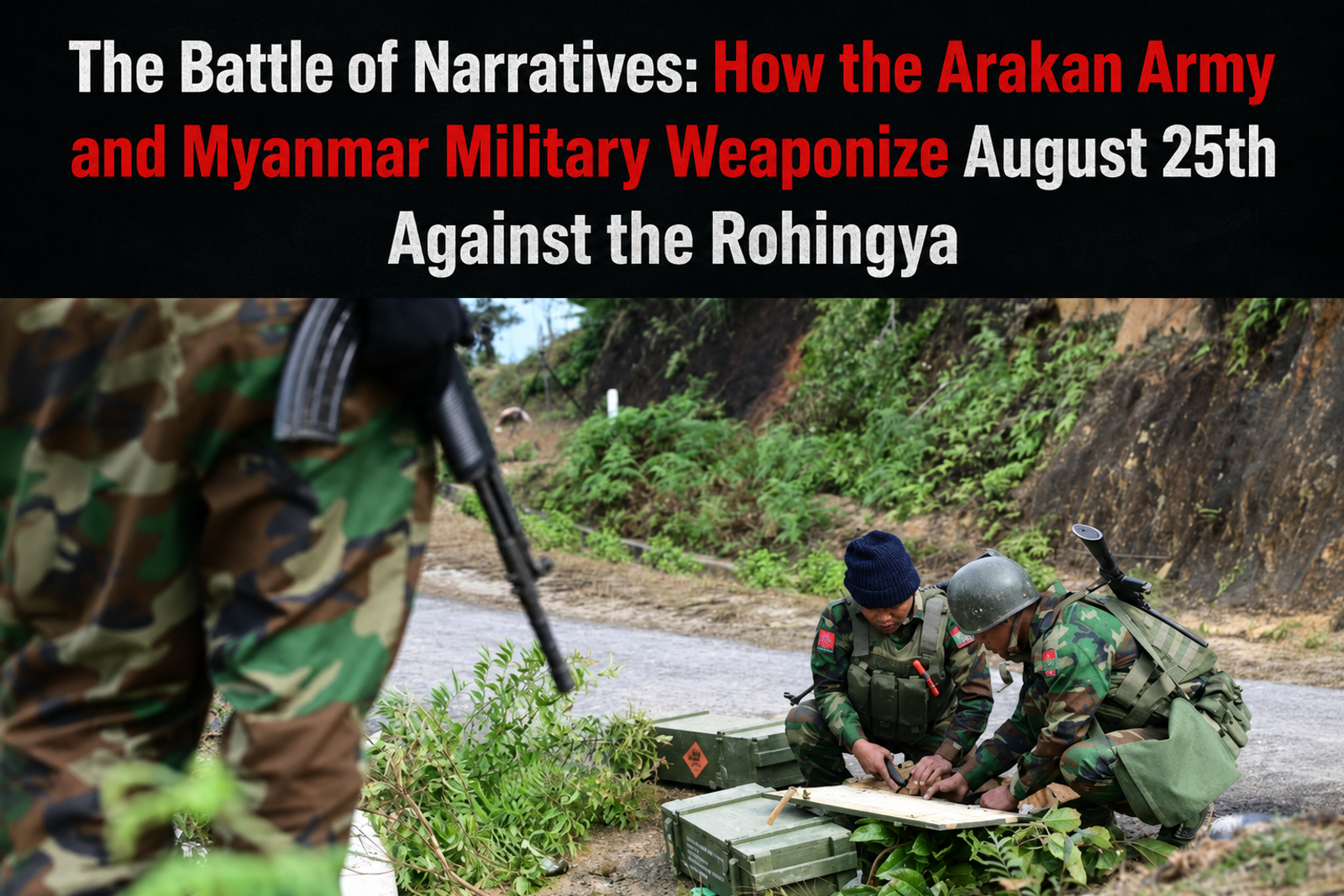
The Battle of Narratives: How the Arakan Army and Myanmar Military Weaponize August 25th Against the Rohingya

On August 25, 2026, marking nine years since the 2017 genocide against the Rohingya by the Myanmar military and local ethnic Rakhines, the militant Arakan Army (AA) unexpectedly organized a commemorative event with local Hindus in Arakan State, coinciding with global Rohingya remembrance events.
The Arakan Army framed this event around a new agenda, marking the day as a Hindu genocide remembrance day committed by the Arakan Rohingya Salvation Army (ARSA). Notably, this event was never observed by the Hindu community prior to the Arakan Army gaining territorial control. It appears to be a calculated effort to deflect from the universally recognized Rohingya genocide day and shift blame onto the Rohingya.
The core question remains: How could such a thing even happen? On August 25th, thousands of Rohingya were killed, and we mark this day as a dark day in our history. Yet, they claim that Rohingya Muslims or ARSA killed 99 Hindus on that exact same day. How can anyone believe this while the entire state was plunged into darkness under massive destruction, violence, and genocide by the Myanmar military?
Living through that period, we know how strict the restrictions were; people didn't even have simple knives to cut fish, and ARSA only had basic wooden sticks and a few swords against heavy guns. During those black days when our people were being slaughtered, nobody had the capacity to carry out such an atrocity. Those early investigation reports were simply managed and manufactured by the Myanmar military.
Recently, media outlets like Arakan Times interviewed Hindu refugees in the Kutupalong camp, where individuals and families clarified the truth: none blamed Rohingya Muslims, stating instead that the persecution and mass killing of nearly a hundred Hindus were carried out by the Myanmar military.
For the past nine years, no Hindu group observed August 25th as an ARSA-led massacre remembrance day. This new campaign is a politically orchestrated narrative heavily promoted by Arakan Army propaganda platforms, including the Global Arakan Network, Narinjara, and the Development Media Group, alongside a network of Rakhine supporters across Asia. Independent research organizations, such as Washington D.C.'s Jamestown Foundation, have previously documented these propaganda networks.
Our documentary team's interviews with Hindu survivors in Kutupalong reinforce these findings, as none implicated the Rohingya or ARSA in the 2017 atrocities. Instead, survivors consistently pointed to the Myanmar military as the sole perpetrator of the indiscriminate killings and sexual violence.
Conclusion
The Arakan Army's August 25, 2026 event functions as a calculated propaganda effort rather than genuine remembrance. By attempting to shift 2017 atrocity blame onto the Rohingya, the Arakan Army contradicts firsthand accounts from Hindu survivors in Kutupalong. This revisionist narrative obscures historical reality and serves as a political tool to shield the actual perpetrators of violence against both Hindus and Muslims.
Meanwhile, the Myanmar military issued a parallel statement on its Facebook page, “Myanmar Mission Geneva,” launching hate speech against the Rohingya, labeling them as Bengalis, and falsely claiming the date marks ARSA attacks on 30 military camps while rejecting Rohingya Genocide Remembrance Day.
Ultimately, enemies often shift narratives to suit their political objectives. Both the Myanmar military and the militant Arakan Army are utilizing the tragic Hindu mass killings to deflect accountability and jointly suppress Rohingya historical truth.