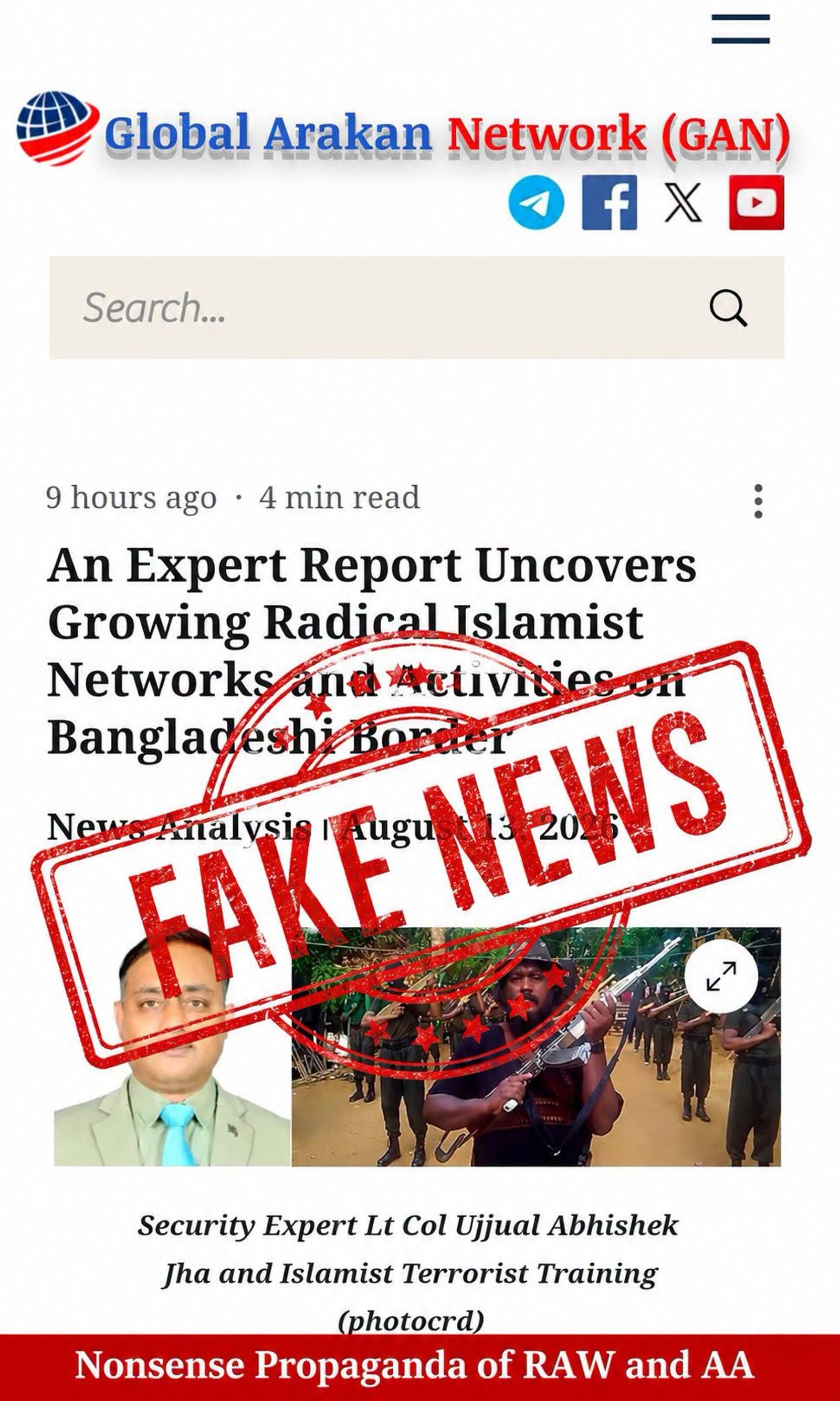
Digital Warfare and the Narrative of Erasure: Analyzing Arakan Army Propaganda Media Tactics

As the conflict in Myanmar’s Rakhine State intensifies, a secondary battleground has emerged in the digital sphere. The Arakan Army (AA) and its political wing, the United League of Arakan (ULA), have increasingly relied on a sophisticated media apparatus to shape international and local perceptions. This digital strategy, often funneled through platforms like the Global Arakan Network and associated social media channels such as Narinjara, Development Media Group, and many more have drawn sharp criticism from Rohingya social activists and human rights investigators who allege the systematic use of disinformation to criminalize and marginalize the Rohingya community on the internet and in the view of globalization.
Arakan Army in a Glance
Arakan Army (AA) and its political wing United League of Arakan (ULA) is a designated terrorist organization operating across the Arakan State of Myanmar to separate the Arakan State as an only ethnic Rakhine country as Arakan.
This organization has been active in various terror attacks since its major control of Arakan State against all other ethnicities living in the Arakan State. The targeted violence and massacres on Rohingya civilians by the Arakan Army have been documented by world media outlets including Human Rights Watch (HRW), Fortify Rights, and International and local activists.
Similarly, dozens of indigenous Chakma organizations have published statements on serious crimes including open gunfire and killing, arbitrary detention, landmines explosions and sexual violence against Chakma across Arakan State since it has seized control of major parts across Arakan State.
It’s not limited to. The Arakan Army (AA) has been using many media outlets under their own with several names and writing contents against Rohingya civilians while justifying the terror activities of the Arakan Army (AA). Due to these reasons, the internet is now full of disinformation against the indigenous Rohingya ethnic being spread by major media platforms of the Arakan Army. This is the double standard pattern of genocidal tactics used by the Myanmar military for decades to drive out Rohingya from their own land systematically. I explained the root strategies of the Myanmar military and its allied (Rakhine armed groups, Arakan Army as of present) to drive out the Rohingya from their own land in this video.
The Architecture of AA Propaganda
The AA’s media operations are characterized by a multi-platform approach designed to reach both the Rakhine diaspora and the broader international community. These channels often present a curated version of events on the ground, serving several strategic purposes:
- Territorial Legitimacy: Presenting the AA as the sole legitimate administrative authority in Rakhine State.
- Narrative Control: Redirecting international focus away from reported massacres and toward alleged "counter-terrorism" activities.
- Historical Revisionism: Efforts to dispute the indigenous status of the Rohingya people, often labeling them as "illegal immigrants" or "outsiders".
The Global Arakan Network, along with its social media presence, functions as a primary node in this network. By utilizing high-production value documentaries and targeted social media campaigns, these entities attempt to "cleanse" the narrative of the AA's reported human rights violations and criminalize the indigenous Rohingya ethnic.
Criminalization and "Targeted Information"
A central pillar of the AA's media strategy is the criminalization of the entire Rohingya community. Reports suggest that AA troops and media outlets frequently employ coercive tactics to enforce a self-imposed "military service law," while simultaneously labeling those who resist or flee as terrorists or collaborators.
The common narrative of today’s world and in today’s history of Arakan State, when muslims fight against injustice and such genocide/violence, they become terrorist immediately and banned from many digital platforms or international bodies while non muslims attack and massacre thousands of muslims, this is not terrorism, this is simply human rights violation or just a mistake during the war. This narrative is a one sided narrative and targeted campaign only against muslims.
Key Tactics of Disinformation
- False Accusations as Justification: The AA has frequently claimed its operations are necessary to counter "ARSA activities". However, activists and human rights organizations have described these claims as unfounded and used deliberately to justify territorial expansion and the persecution of ethnic minorities.
- Visual and Narrative Distortions: The use of targeted information aims to portray the Rohingya as a security threat. This includes spreading politically motivated information, unverified accounts of communal violence to stoke fear and hatred among the Rakhine Buddhist population. Rakhine Buddhist population across many countries especially in Rakhine (Arakan) State, Malaysia, Bandarban, India and many other countries have been spreading hate speeches and false information against Rohingya on the internet and abusive comments but social media either don’t understand their texts or deliberately ignore to remove their contents or accounts.
- Erasure of Identity: By systematically disputing Rohingya history and legal rights, these propaganda channels facilitate a broader process of "systematic cleansing". This involves the destruction of homes, seizure of livestock, and the permanent alteration of demographic compositions in areas like Maungdaw, Buthidaung, and Rathedaung townships in Northern Arakan State.
International Consequences and Growing Scrutiny
The proliferation of these propaganda efforts has not gone unnoticed. The United Kingdom is currently reviewing evidence for possible targeted sanctions against the Arakan Army and the ULA due to mounting allegations of abuses against Rohingya civilians. This potential shift in policy reflects an increasing international recognition that the AA's digital and physical operations are inextricably linked to grave violations of international law.
- Disinformation Campaigns: Increased communal hatred and social exclusion.
- Criminalization of Civilians: Justification for forced recruitment and execution.
- Demographic Alteration: Permanent displacement and loss of ancestral land.
- Narrative Diversion: Burying reports of massacres, such as in Htan Shauk Kan.
Voices of Concern and Resistance
Rohingya activists emphasize that the digital erasure of their history is a precursor to physical violence. Personal testimonies highlight how disinformation spread via Facebook, websites, search engines and other social media has reached millions, turning general publics against the Muslim community and leading to widespread arson and killings.
International Human Rights Organizations and Activists call for:
- Independent Investigation: Urgent measures to investigate violations and hold perpetrators accountable under international law.
- Digital Accountability: Greater scrutiny of propaganda channels like the Global Arakan Network by social media platforms and international observers.
- Preservation of Truth: Documenting the real-time abuses, including forced labor, extortion, sexual violence, arbitrary and summary killings, to counter the "false claims" of state-like legitimacy.
Analysis and View of Social Activists
The following analysis and views provided by social activists further illustrate the targeted nature of this propaganda:
Sahat Zia Hero on Facebook says
This is the nonsense propaganda of Indian RAW and the terrorist Arakan Army (AA), spreading misinformation and hate speech against #Rohingya Community.
This is a deeply concerning example of propaganda and misinformation that appears designed to promote hostility toward the Rohingya community. The claims and narratives being circulated must be critically examined and independently verified rather than used to spread hate or incitement.
As governments and international actors discuss the possibility of Rohingya repatriation, the international community must urge all relevant actors, including the Arakan Army (AA), to reject hate speech, anti-Rohingya rhetoric, and anti-Muslim narratives.
The AA must change this approach and stop campaigns that target the Rohingya community. Such rhetoric risks further deepening mistrust, increasing tensions, and creating a serious threat to peace, coexistence, and regional stability.
The Rohingya deserve a safe, dignified, voluntary, and sustainable return, not more propaganda, hatred, or fear.
Global Arakan Network deliberately omitted key truths that I clearly stated_ the Myanmar junta regime committed genocide against the Rohingya and resistance against the regime is not only a success for the Rakhine people but also an achievement for Rohingya who have been subjected to genocide. However, fighting the regime must not be used to justify denying or destroying the demographic existence of the Rohingya following the Arakan Army’s control in Northern Rakhine State.
The journalist who participated in the program is a human-rights-oriented professional committed to truth, justice, and ethical journalism. Portraying her as betraying her community simply because she refused to endorse violence or deny civilian harm reflects intolerance toward independent voices, not a commitment to genuine dialogue.
Human rights are universal and indivisible. Sustainable coexistence in Arakan will only be possible through honest dialogue, equal accountability, and the rejection of hate-based narratives.
I remain committed to speaking out against injustice wherever it occurs and whoever commits it.
Conclusion
The digital front of the Rakhine conflict is not merely about information; it is about the power to define who belongs and who does not. As the Arakan Army continues to expand its media reach, the risk of permanent historical and physical erasure of the Rohingya people remains a dire reality. The international community must look beyond the curated narratives of "security operations" to address the systematic persecution occurring behind the digital screen.